
Kindle eBook
- ASIN
- B0HL636ZKD
- Language
- English
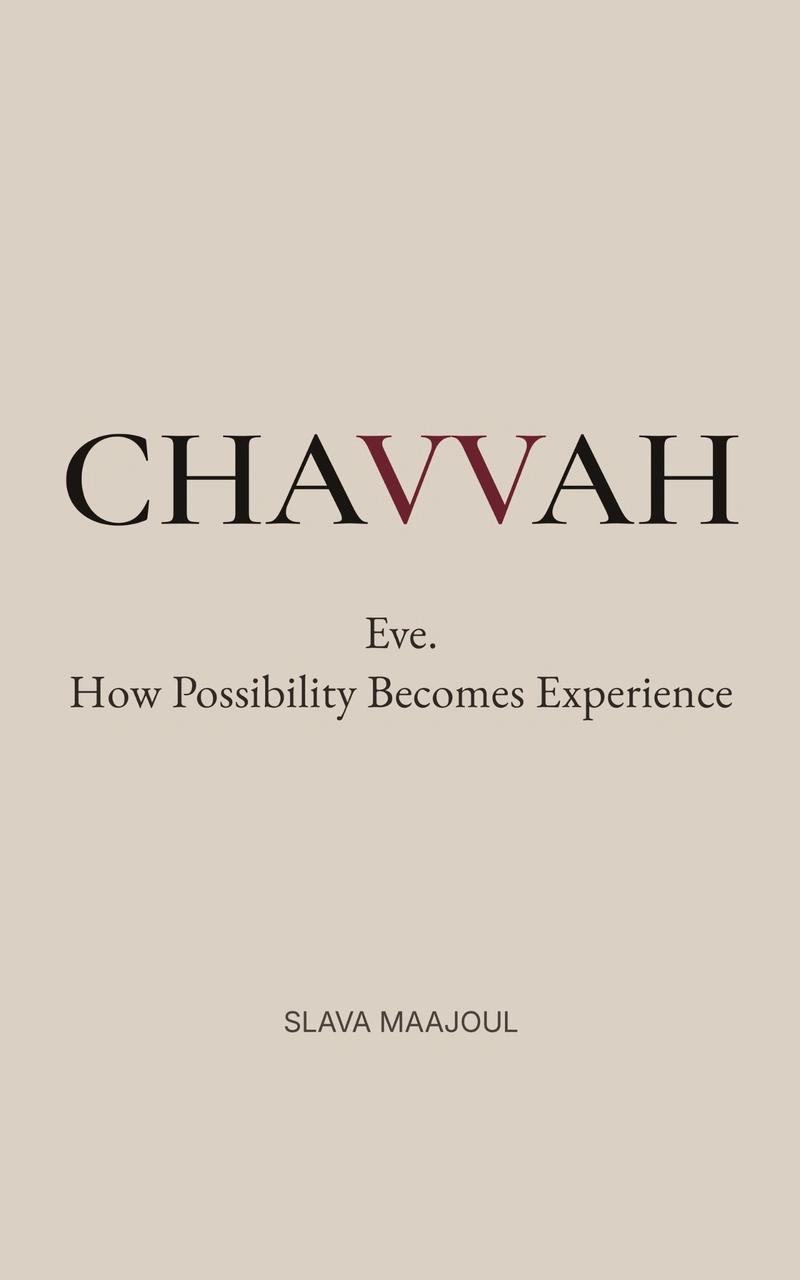
Eve. How Possibility Becomes Experience
An ancient story. A different question: What happens when possibility becomes experience?
Available as Kindle eBook, paperback and hardcover.
External retailer: Amazon. Reading-feature availability is determined by Amazon.
A woman. A tree. A serpent. An apple.
That is how many of us remember the story. Genesis never calls the fruit an apple.
The detail matters because it shows how easily an inherited image can become more visible than its source.
CHAVVAH starts there. Not with the claim that one hidden meaning has finally been discovered, but with the decision to read a familiar story closely enough for it to become strange again.
Adam and Eve has often been read as a story about the origin of guilt. A simple modern reversal would be to clear Eve and accuse someone else.
CHAVVAH takes a harder route.
It asks not only who was right, but what happens when a possibility is chosen and thereby becomes real. What changes when another person cannot be fully possessed or predicted? What happens when the one who sees can also be seen? Where does protection end and avoidance begin? What does responsibility mean when neither total self-blame nor total exoneration is adequate?
The story does not become harmless. It becomes more exact.

Possibility can remain open. Experience cannot.
A real life takes place in this body, in this place, with these people, after these decisions. That is how it acquires shape. Every shape has an edge.
CHAVVAH follows this movement through Genesis 2–3: the first “not good,” the arrival of another person, the boundary, the fruit, opened eyes, “Where are you?”, toil, dust, and finally the name Chavvah.
The result is a philosophy of finitude that neither romanticises limitation nor treats it as nothing but failure.
Another person can answer loneliness. But the most valuable forms of closeness lose their character if they can be fully compelled.
That is why otherness becomes an ethical boundary in CHAVVAH. A no reveals whether the other is truly allowed to remain other. Privacy preserves the fact that self-disclosure is an act, not a debt. A person does not exist to fill another person’s lack on command.
The question of experience becomes a question of relationship.
Responsibility in this book does not begin with the sentence: Everything is your fault.
It begins with a location.
Where am I in what happened? What came toward me? What did I do? What was within my power, and what was not?
An action becomes part of a person’s history without exhausting the whole person. In the distance between “I did this” and “This is all I am,” responsibility can remain possible without collapsing into denial or self-destruction.
CHAVVAH does not make suffering good after the fact in order to rescue a theory.
A wound did not have to be necessary. Pain does not prove meaning. Forgiveness is neither the injured person’s duty nor the offender’s right.
And yet something can arise after a wound that was not secretly contained inside it: a different decision, a boundary, a form of future.
Meaning after an event is not the same as meaning in the event.
By the time toil and dust have been spoken, no child has yet been born. Then the woman receives a name the text associates with the living: Chavvah.
The name reverses nothing. It does not cancel mortality. It does not turn the woman into a timeless definition of womanhood or motherhood.
It appears at a striking place in the story: after reality has acquired a history, and before a future has happened.
CHAVVAH reads this not as doctrine, but as a possibility: life within limits. A future without returning to an untouched beginning.
The book develops the possibility of an All-Whole — a whole with no outside. The idea remains a philosophical working hypothesis.
It is not another word for God and not a proof about the universe. The human and ethical core of the book must still stand if the hypothesis is rejected.
The nearer questions remain: How do we live with difference? Finitude? Another person we cannot own? Decisions that cannot be undone? A future that nevertheless remains open?
The book takes the old text seriously enough not to use it as a shortcut to a new certainty.
For readers who experience philosophy as more than a set of theories.
For those who can take myth, religion and ancient texts seriously without submitting to a single inherited interpretation.
For anyone thinking about freedom, responsibility, relationship, finitude and the possibility of a real life without demanding a simple answer.
The sample is not hosted on this website. Use Amazon’s reading/sample feature for the relevant edition. Current prices and availability are shown on Amazon.